
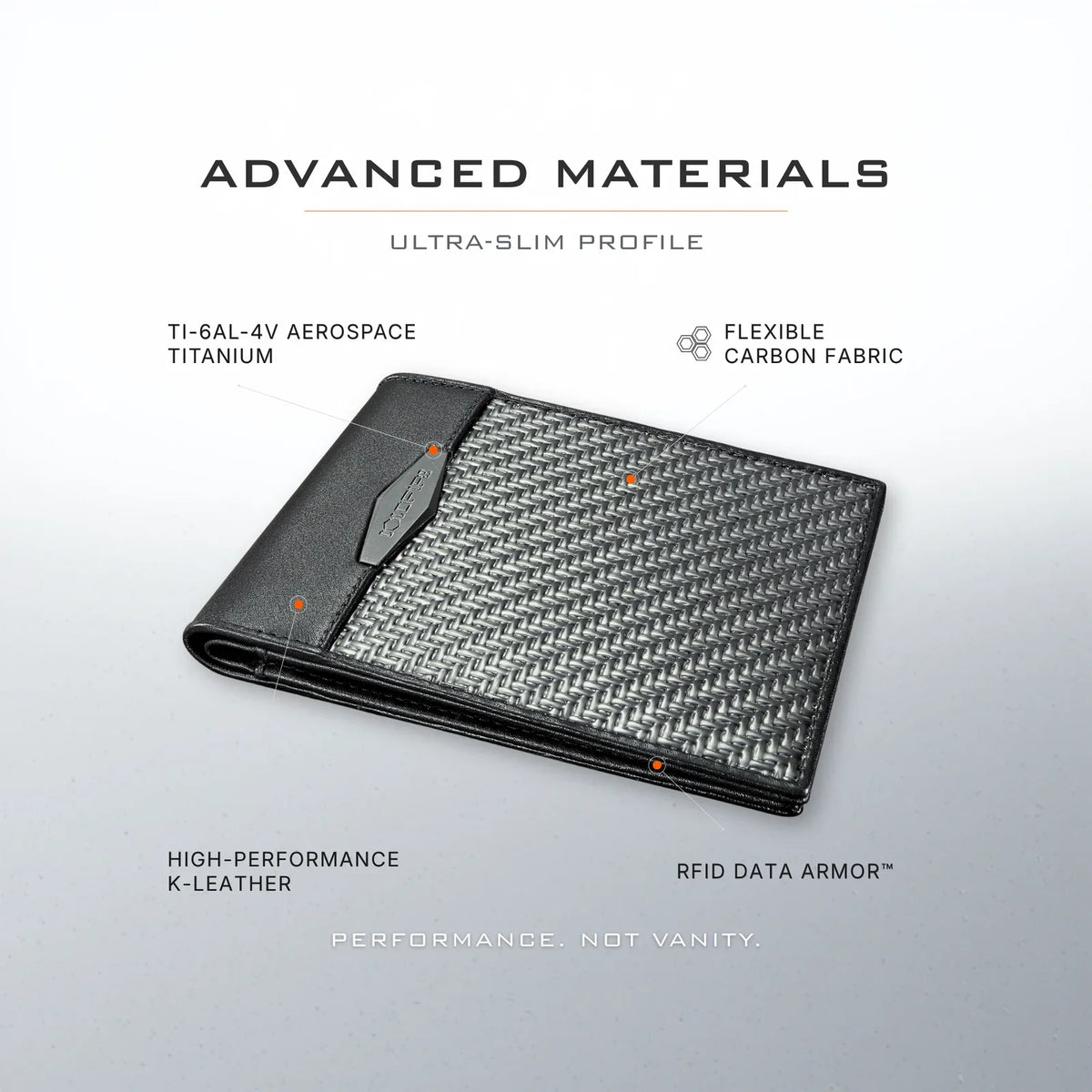
A wallet made from the right material lasts ten to fifteen years of daily carry. One made from the wrong material lasts eighteen months, and the two can look identical in a product photo. This guide ranks the eight materials wallets are actually made from by realistic lifespan, explains how each one fails, and names the one habit that shortens the life of every wallet regardless of material. The figures are drawn from twenty-five years of making leather goods in Plovdiv and from what comes back to us for repair.

The short answer
Ranked by how long the wallet keeps its shape and function under daily carry, within its stated card capacity: flexible carbon fiber composites and kangaroo leather at the top, around ten years or more; full-grain cowhide close behind, eight to fifteen; top-grain cowhide four to eight; nylon fabric two to five; split "genuine" leather two to four; bonded leather one to two. Metal plate wallets are a special case: the plates last indefinitely, the elastic band that makes them work does not.
Lifespan ranges below are typical for daily carry at or under the wallet's rated card count. Carry three cards beyond capacity and divide every number by two or three.
Eight wallet materials, ranked
| Material | Typical lifespan | How it fails | What kills it | Verdict |
|---|---|---|---|---|
| Bonded leather | 1 to 2 years | Peels. The polyurethane surface lifts off the fibre backing, usually at the fold first. | Flexing. Any fold is a future crack line. | Avoid. It is leather dust held together with glue. |
| "Genuine" leather (split) | 2 to 4 years | Scuffs, then cracks. The surface coating wears off and the loose lower split underneath has no grain to protect it. | Abrasion from pockets and card edges. | Entry level. Fine for a wallet you expect to replace. |
| Top-grain cowhide | 4 to 8 years | Stretches and softens. With the strongest fibre layer sanded off, card slots loosen and the fold goes limp. | Card pressure. Slots stretch to the load they carry. | Good. Most mid-price wallets. Keep it within capacity. |
| Full-grain cowhide | 8 to 15 years | Wears gracefully. Patina rather than damage; eventually stitching or lining fails before the leather does. | Overloading and moisture cycling. | Excellent. The traditional buy-it-for-life choice. |
| Kangaroo leather (K-Leather) | 10 to 15 years | Very slow surface wear. Fibres run parallel to the surface, so slots hold their width under load far longer than cowhide. | Solvents and prolonged soaking. Otherwise little. | Excellent, and thinner for the same strength, which is why slim wallets use it. The measurements, with sources. |
| Flexible carbon fiber composite (Carbitex OmniFlex) | 10+ years | Does not stretch, does not crease. Under years of constant overloading and sunlight the surface film can show wear. | Chronic overloading beyond capacity. | Excellent for shape retention, which is the thing leather cannot do. |
| Rigid carbon fiber or aluminium plates | Plates: indefinite. Bands: 1 to 3 years | The plates are fine for decades. The elastic strap or spring that holds the cards is the whole wallet, and it stretches out. | Elastic fatigue. Replaceable on some models, not on all. | Good if the strap is replaceable and you like the format. |
| Nylon and polyester fabric | 2 to 5 years | Frays at the pocket mouth and wears through at card corners. Ripstop and bonded edges extend this considerably. | Blade-cut edges and thin weaves. | Fair. Light and cheap. Look for ripstop and laser-cut edges. |
Why leather grades matter more than brand
A hide is split into layers. The top layer with the natural grain intact is full-grain, the strongest part. Sand the surface off and it is top-grain, more uniform and weaker. The lower layers left over are sold as "genuine leather", a grading term that sounds like a promise and describes the cheapest cut. Bonded leather is not a cut at all: it is leather fibre waste mixed with adhesive and pressed onto a backing with an embossed fake grain.
The grade decides the lifespan more than anything the brand does afterwards. A full-grain wallet from an unknown maker will outlast a bonded leather wallet from a famous one. The practical test is the cut edge: full-grain shows one dense, fibrous cross-section; bonded shows a uniform layer sitting on a different-coloured backing.

Where carbon fiber fits, honestly
Two very different things are sold as "carbon fiber wallets". Rigid plate wallets are machined or moulded carbon plates held together by an elastic strap. The plates are nearly indestructible in a pocket. The strap is a consumable, and when it goes slack the wallet is finished unless the maker sells replacements.
Flexible carbon fiber composites are a newer category: carbon fibre textile bonded to a flexible film so it folds like leather but does not stretch. We use Carbitex OmniFlex (CX6) for this reason: a card slot cut in it stays the width it was cut at, which no leather can promise. We will also say what we have seen in the field. One of our own early CX6 wallets, carried three to four years permanently overloaded with two or three extra cards and cash, and left in sunlight, eventually showed white specks on the surface where the film had worn under constant tension. Kept within capacity it would not have happened, and the current OmniFlex sheets are denser than that early material, but "looks the same forever" is not a claim we make about any material, including ours.
The parts that fail before the material does
On a well-made wallet the shell is rarely the first thing to go. Three components decide the real lifespan and none of them is in the headline material name.
- Thread. Plain polyester thread abrades at the fold and the seam opens. Bonded polyamide thread (we use AMANN Strongbond) has a coating that resists this and is the difference between a seam that lasts three years and one that lasts fifteen.
- Lining. Cards slide across the lining thousands of times a year. Thin plain-weave fabric frays at the pocket mouth; a ripstop with laser-cut edges does not. We covered this in detail in Wallet Linings Compared.
- Edges. A painted edge chips; a raw edge frays. A turned or welted edge, where the leather is folded over the core, has nothing exposed to wear.

The one habit that shortens every wallet's life
Overloading. Every wallet is shaped for a card count. Two or three cards beyond it put permanent tension on the slots, the fold and the stitching, and the wallet ages in months instead of years. It is the reason a 200 euro wallet and a 40 euro wallet can both be ruined in a year, and the reason our five-year structural guarantee is written around "within stated capacity". The second habit is the back pocket: a wallet that is sat on all day is folded under body weight several thousand times a year. Front pocket carry roughly doubles the life of any wallet, which is why we build the Flex series for it.
How to buy a wallet that lasts
- Ask for the leather grade in words. Full-grain or top-grain. "Premium leather" and "genuine leather" are not grades you want.
- Ask what the thread and lining are. A brand that names them has chosen them. A brand that does not has chosen the cheapest.
- Count your cards and buy the capacity. Not the capacity you wish you needed.
- Check the warranty wording. A warranty that covers "stretching and loss of shape" is a maker that expects the shell to hold. A warranty that covers "manufacturing defects" only covers the first month.
- COLDFIRE shell
- Carbitex OmniFlex (CX6) flexible carbon fiber, Carbitex Inc., USA
- Leather
- K-Leather kangaroo leather, Packer Leather, Australia
- Lining
- Dyneema ripstop, laser-cut
- Thread
- AMANN Strongbond bonded polyamide, OEKO-TEX Standard 100
- Hardware
- Grade 5 Ti-6Al-4V titanium, DLC-coated
- Guarantee
- Five years against stretching, swelling and loss of shape within stated capacity
Every material above is listed with its maker on the Engineering and Quality page. If you want to compare brands on this, our Wallet Material Transparency Audit scores 24 of them on what they disclose.
Lifespan questions, answered
How long should a good wallet last?
A wallet made from a single piece of full-grain leather, or from a composite shell such as flexible carbon fiber, should last 8 to 15 years of daily carry when kept within its card capacity. A 30 to 60 euro wallet in split or bonded leather typically lasts 1 to 3 years.
What is the most durable wallet material?
For resistance to stretching and shape loss, flexible carbon fiber composites and kangaroo leather lead, because neither elongates under card pressure. For pure abrasion and impact, machined aluminium and titanium plate wallets are hardest to damage, but their elastic bands are the weak point. Full-grain cowhide sits just behind, and everything below top-grain is short-lived.
Is kangaroo leather really stronger than cowhide?
At equal thickness, yes. The figure quoted from CSIRO-era research in Australia is roughly ten times the tensile strength of cowhide at the same thickness (independent maker tests found about four times), because its collagen fibres run parallel to the skin surface rather than crossing it. In a wallet that shows up as card slots that do not stretch. We set out the figures, their sources and the honest limits of the comparison in Kangaroo Leather vs Cowhide.
Why do cheap wallets fall apart so fast?
Three reasons that usually arrive together: bonded or split leather that peels or cracks, a thin blade-cut fabric lining that frays, and unbonded polyester thread that wears through at the fold. None of them is visible on a product photo, all of them are visible by year two.
Does carbon fiber last forever?
No material does, and we say so from our own experience. Rigid carbon plates do not stretch or crack in a pocket, but their elastic bands wear out. Flexible carbon fiber composites hold their shape for many years, but under constant overloading and sunlight the surface film can eventually show wear. Kept within capacity, a carbon fiber wallet outlasts almost any leather one; overloaded, nothing lasts.
What kills a wallet fastest?
Overloading. Every material has a card count it was shaped for. Two or three cards beyond it put permanent tension on the slots, the fold and the stitching, and the wallet ages in months instead of years. The second killer is the back pocket, where the wallet is sat on and folded under body weight all day.
Written by Todor Georgiev, founder of COLDFIRE and a leather goods manufacturer in Plovdiv since 2000. Published 28 October 2026. Lifespan ranges are typical values from manufacturing and repair experience, not laboratory figures, and assume daily carry within the wallet's stated capacity.

Share:
Kangaroo Leather vs Cowhide: Strength, Thickness and Durability in Wallet Engineering
Do You Need an RFID Wallet? What Contactless Skimming Can and Cannot Do